
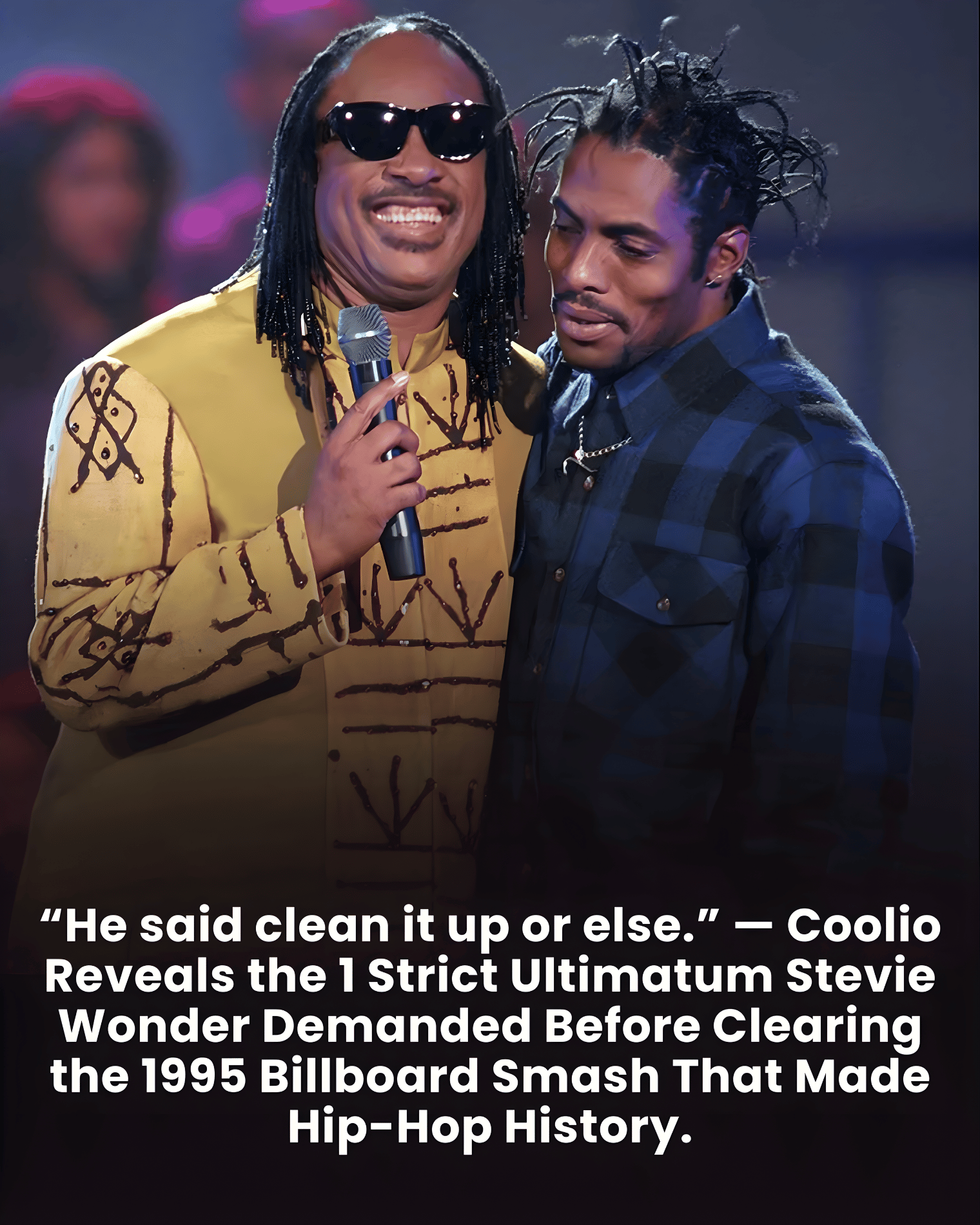
In the mid-1990s, hip-hop was rapidly expanding into the mainstream, but the genre still faced heavy scrutiny from radio programmers, television networks, and record executives concerned about explicit lyrics. One of the most fascinating turning points in that era came from an unexpected source: a strict condition set by music legend Stevie Wonder that ultimately helped shape one of the biggest rap songs of the decade.
The story centers on Coolio, who in 1995 was working on a track that sampled Wonder's haunting 1976 song Pastime Paradise, originally featured on the album Songs in the Key of Life. The sample carried a dramatic choir arrangement and powerful melodic progression that immediately gave Coolio's track an emotional gravity. From the moment the beat came together, it sounded like a potential hit.
But there was one problem: Stevie Wonder had to approve the use of his music.
In the music industry, sampling another artist's work requires permission from the copyright holder. Without clearance, the new song cannot legally be released. When Coolio's team approached Wonder to request permission for the sample, the legendary singer-songwriter reportedly listened carefully to the proposed track—and refused.
Wonder's objection was not about money or artistic rivalry. Instead, it came down to language and message. The early version of the song contained profanity, something Wonder strongly opposed associating with his music. Known for his deep spiritual values and socially conscious songwriting, Wonder made it clear that he would not allow his composition to be used in a track containing explicit language.
His message to Coolio's camp was simple: clean up the lyrics, or the sample would never be cleared.
For Coolio, the decision was a difficult one. The sample was the emotional centerpiece of the song, and losing it would mean abandoning the entire track. Rather than walk away, he returned to the studio and rewrote the verses, stripping out the profanity while keeping the core message intact.
The rewriting process had an unexpected effect. Without relying on aggressive language, the lyrics leaned more heavily into storytelling and reflection. The song's narrative about life in dangerous neighborhoods, moral choices, and the struggle to escape violence became more universal and introspective.
The final result was Gangsta's Paradise, released in 1995 as part of the soundtrack for the film Dangerous Minds. The track quickly exploded into a global phenomenon. Its haunting choir hook, powerful storytelling, and accessible language allowed it to reach audiences far beyond traditional hip-hop listeners.
"Gangsta's Paradise" topped charts around the world, including the Billboard Hot 100, and went on to sell millions of copies globally. The song also became one of the defining hip-hop records of the 1990s, proving that rap could tackle serious social themes while remaining commercially successful.
In hindsight, Wonder's strict condition may have been one of the reasons the song resonated so widely. By insisting on clean lyrics, he inadvertently pushed the track toward a broader audience, making it playable on radio stations and accessible to listeners who might otherwise have avoided explicit rap music.
For Coolio, the experience became a powerful lesson in artistic discipline. What initially felt like a frustrating obstacle ultimately helped transform the track into a timeless classic.
The collaboration between the two artists—though indirect—created a rare musical bridge between soul and hip-hop. And decades later, the song remains proof that sometimes a creative limitation can become the very thing that elevates a song into history.